


Enhancing Food Safety Compliance: Markoprint Thermal Inline Inkjet Printers and AMI/Reiner Handheld Printers
In the food manufacturing industry, compliance with Food and Drug Administration (FDA) and United States Department of Agriculture (USDA) regulations is paramount. One essential aspect of these regulations is the coding of lot and date information on food products. While dates primarily indicate product quality, they also play a crucial role in ensuring food safety. Markoprint Thermal Inline Inkjet (TIJ) printers and AMI/Reiner handheld printers empower food manufacturing companies to meet FDA and USDA coding regulations, resulting in improved efficiency, reduced downtime, increased throughput, and ultimately safer products for consumers.
What are Quality Dates?
The USDA states that dates on food products are primarily provided to help consumers and retailers determine the best quality of the product. While they are generally not required by federal law, manufacturers carefully consider various factors such as distribution time, storage temperature, food characteristics, and packaging type to determine the optimum quality dates for their products. It is important to note that quality dates are not indicators of safety, with the exception of infant formula. In the case of infant formula, packaging is required to carry a “Use By” date – which ensures that the product will provide the indicated level of nutrients carried on the labeling, if consumed by that date. The USDA also requires pack dates on poultry and thermally processed, commercially sterile products, to trace back product supply chains in the event of a foodborne illness outbreak.
Food products like meat, poultry and eggs under the purview of the Food Safety and Inspection Service (FSIS) may have voluntarily applied quality dates, so long as that information is truthful, not misleading, and complies with FSIS Regulations. Fresh products like meat, poultry and eggs typically have open dates on them, while shelf-stable products may carry open dates or closed dates.
Open dating, utilizes a conventional calendar date and is typically found on perishable items like meat, poultry, eggs, and dairy products, which allows consumers to evaluate the freshness of the product. A common example of an open date is a “sell-by” or “use-by” date. Shelf-stable products, on the other hand, often feature “closed” or “coded dates” that are represented by a series of letters and/or numbers. Closed or coded dates often display the date the product was manufactured or packaged.
Enhancing Efficiency and Precision with Markoprint TIJ Printers:
Markoprint TIJ printers are an ideal solution for food manufacturing companies seeking efficient and reliable date coding, or other product identification marking. These printers are designed for inline integration into production lines, enabling seamless and automated coding processes. By utilizing advanced thermal inkjet technology, they provide high-resolution printing capabilities, ensuring clear and legible codes on various primary, secondary and tertiary packaging materials.
With the ability to print on both porous and non-porous surfaces, Weber Markoprint TIJ printers offer versatility, accommodating a wide range of food packaging requirements. This flexibility saves manufacturers valuable time and resources by eliminating the need for separate coding systems for different packaging materials. Markoprint TIJ printers also offer many benefits over other printing technologies.
Boosting Throughput while Minimizing Downtime:
Markoprint TIJ printers excel at enhancing production throughput while minimizing downtime. With their efficient ink cartridges, these printers can handle high-volume printing, reducing the frequency of ink replacements and minimizing interruptions in the production line.
Markoprint’s innovative ink management system utilizing Hewlett Packard (HP) smartcard technology, ensures consistent print quality throughout the cartridge’s lifespan, eliminating the need for frequent printhead cleaning or maintenance. This optimized workflow enhances overall production efficiency, enabling food manufacturers to meet demanding coding requirements without compromising productivity.
Exploring the Power of AMI/Reiner Handheld Printers for Mobile Printing:
While Markoprint TIJ printers excel at inline coding, handheld printers are invaluable in situations where flexibility and mobility are crucial. AMI/Reiner handheld printers offer the convenience of portable printing, allowing operators to code on-demand or perform manual coding tasks, like rework, small batch coding, or coding on test batches among other applications.

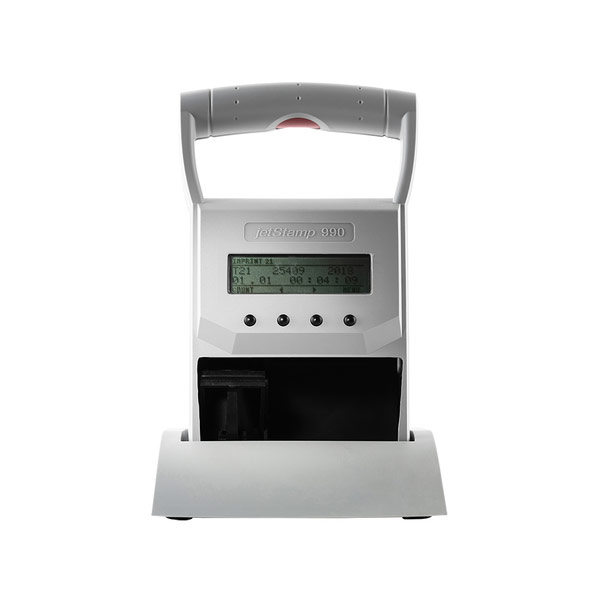


AMI/Reiner handheld printers are lightweight, compact, and user-friendly, allowing operators to swiftly apply date codes, lot numbers, and other crucial information to food products. Their versatility accommodates virtually limitless packaging types, like porous and non-porous surfaces, as well as uneven, concave or convex surfaces, enabling food manufacturers to comply with labeling regulations even in complex or challenging production environments.
By enabling precise and reliable date coding, both Markoprint’s inline printers and AMI/Reiner handheld printers contribute to improved food safety in over one hundred thousand facilities across North America and around the world. Accurate and legible codes engender confidence in consumers, facilitate logistics and handling, and aid product traceability, enabling swift identification and recall of potentially unsafe products. Explore further details on a notable recall, such as Tyson’s chicken nugget incident, by clicking here. This process not only protects consumers but also safeguards the reputation and credibility of food manufacturing companies.
For more information on how AMI can help enhance productivity in your industry, please feel free to contact us.