


Guide To Proper Meat Label Requirements
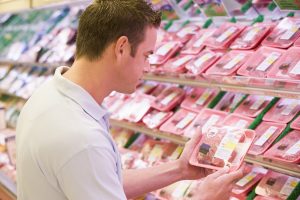
Man checking labels on fresh meat
Product labels are a critical aspect of the packaging process – especially for food products. From expiration dates, best by dates to grading, food products often require a plethora of codes to comply with distribution chains and state and federal laws. It’s also critical that label applicators don’t tangle, have accurate placement and don’t waste labels.
All of that is particularly true of meat packaging and meat processing labels, marks and codes.
Due to the spoiled meat, risks of disease, and production uptime, meat packaging labels are subject to some of the most stringent legislative rules for all food products.
Below we’ll detail the best options available for meat packaging and processing labels and marking – as well as review the current USDA meat labeling requirements.
USDA meat labeling requirements: What are the rules?
In the US, meat label requirements come from three sources: (1) states, (2) the Food and Drug Administration (FDA), and (3) the US Department of Agriculture (USDA).
Within the USDA, the Food Safety and Inspection Service (FSIS) is responsible for ensuring the US’s commercial supply of meat, poultry, and egg products are “safe and correctly labeled and packaged. FSIS issues policy guidance and information, memorandums, and nutrition labeling information.”
These are the USDA’s meat labeling requirements:
- Product name. The name must define the product accurately using USDA-FSIS-approved definitions.
- Official inspection legend (inc. establishment number). The official inspection legend and establishment number are unique to both federal and state processing facilities.
- Address line.
- Net weight or quantity. This can be omitted if the meat is from a butcher or retail counter.
- Ingredient list. Lists the ingredient elements in order of their inclusion in the final product – for example, generic terms like “spices” or “seasonings” or allergens (e.g., wheat, shellfish, eggs, fish, peanuts, milk, tree nuts, and soy).
In addition to these stringent USDA meat label requirements, meat packaging labels can also include grading (as per the USDA’s grading terms), animal living conditions (e.g., free-range or pasture), animal diet claims (e.g., grass-fed, grain-fed), animal raising claims (e.g., raised without antibiotics), and other relevant information.
Furthermore, states can also specify certain labeling requirements. Some states, for instance, necessitate an expiration or freeze-by date on the meat, whereas others do not. And distribution centers will need barcodes, batch codes, animal reference codes, and other tracking information.
Choosing the right label and print option for your meat packaging
While the meat label packaging stay somewhat consistent, the product comes in all manner of packaging types. You need a labeling and printing solution capable of handling all these challenges, from plastic, film, bags to rigid plastic containers and paper cartons.
AMI offers a a couple of TIJ (thermal inkjet) printers, like the IP65 thermal inkjet Zenjet Ultra IP65: made of stainless steel and the ProTIJ 1 turnkey coding solutions designed to replace CIJ printers and other print technologies with ease. Then, the CAMI Label line of print and apply label applicators is a simple, yet technologically advanced solution for labeling products and packages.
When selecting a printer, there are three different factors to consider:
- Packaging material you are printing on
- Ink adhesion and drying time
- Production and processing conditions
Packaging material you are printing on
Due to the variety of meat products there is an extensive range of packaging options. For producers, this creates a significant labeling challenge, namely, how to ensure labels are robust and reliable no matter the substrate being printed on.
Whether the substrate is plastic, film, flexible packaging, cardboard, or another material, selecting a one-size-fits-all printer and ink type isn’t viable. However, thermal inkjet (TIJ) printers do provide a level of unparalleled versatility because of the low-to-no maintenance required and reliability.
In addition, TIJ printers can use both water-based and solvent-based inks to produce durable and crisp imprints. Water-based inks are best for paper surfaces; whereas non-porous substrates like metal or plastic tend to favor solvent-based inks.
In adhesion and drying time
Depending on your production facilities, the ink’s drying time is essential to ensure the line doesn’t slow down. Even in smaller, batch-scale settings, manufacturers want an ink that dries quickly without seeping through the packaging (thereby contaminating the product). Plus, many protein plants require daily wash-down facilities, potentially blurring slower drying inks.
In the worst-case scenarios, slow-drying ink will smudge, becoming illegible and potentially opening up a producer to action from the USDA, FDA, or their state. Moreover, if barcodes and other tracking codes become unreadable, product tracing cannot occur, creating further problems with the distributor.
TIJ printers are among the fastest drying on the market, especially when paired with industrial-grade inks.
Production and processing conditions
Food packaging plants are some of the most challenging printing environments. Depending on the type of meat product, the environment can be:
- Moist, wet, and high temperature
- Excessively dry
- High dust and particulates
That’s where the IP65 Zenjet Ultra excels. The IP stands for “Ingress Protection”: an international standard of sealing effectiveness that encloses the printer’s electrics against dust, dirt, moisture, and more. Meanwhile, the 65 has two separate meanings:
- The 6 refers to solids, i.e., the product Is 100% sealed against foreign objects, like dust and particulates. It also prevents users from touching potentially hazardous electrical components.
- The 5 refers to liquids, i.e., the product is protected against moisture and humidity. With wash-down requirements common in protein plants, this is a printer capable of withstanding moist, wet, and high-temperature conditions.
Choose a versatile and effective printing solution
Avoid printer downtime, labeling errors, and illegible labels with a trusted printing solution. Using our advanced thermal inkjet printers and label applicators, protein producers can label their products safe in the knowledge that they’ll remain regulatory compliant.
We’ve spent decades honing our printing and labeling solutions and have the expertise and equipment suitable to all your printing needs.
Contact our team to find out more about your options for meat processing labels and meat packaging labels.